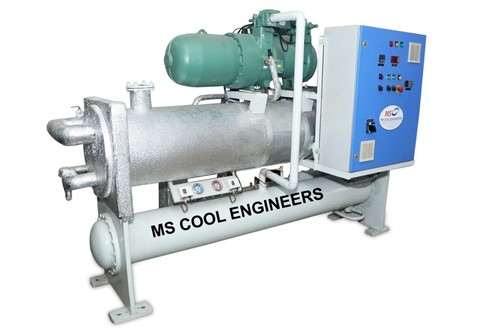
About Three Phase Brine Chiller
Specification
|
Tonnage
|
65 TR
|
|
Tank Capacity
|
1000 Litre
|
|
Phase
|
Three Phase
|
|
Cooling Capacity
|
10000 Litre/Hour
|
|
Brand
|
MS Cool Engineers
|
|
Automation Grade
|
Automatic
|
|
Voltage
|
440 V
|
|
Country of Origin
|
Made in India
|
|
Body Material
|
Mild Steel
|
|
Frequency
|
50/60 Hz
|
|
Chiller Type
|
Air Cooled
|
|
Surface Finish
|
Color Coated
|
Precision Cooling for Industrial ProcessesOur Brine Chiller ensures precise temperature management, catering to demanding process cooling requirements in industries such as chemicals, pharmaceuticals, and food processing. With microprocessor-based controls and highly efficient heat exchange systems, you can maintain optimal conditions for production and storage, enhancing both product quality and operational reliability.
Flexible Installation & CustomizationDesigned for maximum flexibility, the brine chiller comes in packaged and modular types, skid-mounted for easy integration. Customizable dimensions and construction materials allow adaptation to specific space and application needs. Its robust build using mild steel or stainless steel ensures durability, even under challenging operational conditions.
FAQs of Brine Chiller:
Q: How does the Brine Chiller ensure safe operation during extreme ambient conditions?
A: The Brine Chiller is engineered to operate efficiently in ambient temperatures up to 50C. Safety features such as overload protection, phase failure protection, and high/low pressure switches provide comprehensive safeguards, minimizing operational risks and ensuring continuous, trouble-free performance.
Q: What industries and applications commonly use this Brine Chiller model?
A: This Brine Chiller is widely utilized in industrial process cooling for the chemical industry, food and beverage manufacturing, and pharmaceutical production. Its broad temperature range and reliable operation make it suitable for various process cooling needs, from storage to batch processing.
Q: When is it ideal to choose an air-cooled versus a water-cooled Brine Chiller?
A: Choosing between air-cooled and water-cooled models depends on your sites water availability, ambient conditions, and cooling demand. Air-cooled chillers are preferred where water resources are limited or for easier installation, while water-cooled options deliver higher efficiency and are suitable for large-scale, continuous operations.
Q: Where can the Brine Chiller be installed, and is it customizable to fit the available space?
A: The chiller is skid-mounted for flexible placement within industrial facilities and can be customized in size and construction materials to align with specific spatial or operational requirements. This adaptability helps streamline installation and maximize utility in varied environments.
Q: What process controls and monitoring features are available on the Brine Chiller?
A: The unit is equipped with a microprocessor or digital controller and a digital display that shows real-time temperature and system alarms, making monitoring and adjustment straightforward. These controls contribute to precise temperature management and immediate troubleshooting.
Q: How does using high-efficiency evaporators and advanced compressors benefit system performance?
A: High-efficiency plate heat exchangers (PHE) or shell & tube evaporators maximize heat transfer, while hermetically sealed scroll or semi-hermetic compressors ensure reliable, energy-efficient operation. This combination results in consistent cooling, lower energy consumption, and minimal maintenance requirements.
Q: What are the advantages of the Brine Chillers material and construction options?
A: Selecting powder-coated mild steel or stainless steel provides corrosion resistance and long-term durability. This means the chiller remains reliable even in demanding industrial environments, while customizable options ensure compatibility with existing infrastructure.





 Send Inquiry

 Send Inquiry

